NHS Merseycare - Restorative Just Culture
Theory and Practice
NHS Merseycare is a Mental Health and Community Organisation with over 8,500 members of staff. The link below is a short film based around a real-life high performing example of a healthcare environment implementing a ‘Restorative Just Culture’ (Dekker, 2018).
Since this film was produced and shared in 2016, further research has been conducted by Dekker and his team into how a Restorative Just Culture has not just improved working relationships with more open and honest conversations, or how patient safety has improved, but also the more difficult evidence of how things have improved economically (Kaur et al, 2019).
Activity:
Read the article ‘Restorative Just Culture: a study of the Practical and Economic Effects of Implementing Restorative Justice in an NHS Trust’ by Kaur, de Boer, Oates, Rafferty, Dekker (2019).
A summary of the key findings in this article is shared below:
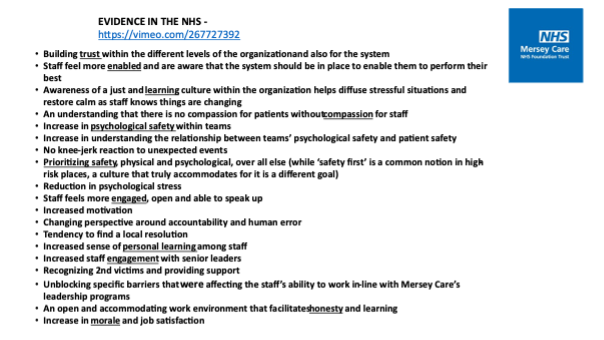
Click to reveal a text version of the above
- Increase in good faith and sensemaking
- Building trust within the different levels of the organization and also for the system
- Staff feel more enabled and are aware that the system should be in place to enable them to perform their best
- Awareness of a just and learning culture within the organization helps diffuse stressful situations and restore calm as staff knows things are changing
- An understanding that there is no compassion for patients without compassion for staff
- Increase in compassionate leadership
- Increase in psychological safety within teams
- Increase in understanding the relationship between teams’ psychological safety and patient safety
- No knee-jerk reaction to unexpected events
- Prioritizing safety, physical and psychological, over all else (while “safety first” is a common notion in high-risk places, a culture that truly accommodates for it is a different goal)
- Reduction in psychological stress
- Staff feels more engaged, open and able to speak up
- Increased motivation
- Changing perspective around accountability and human error
- Tendency to find a local resolution
- Increased sense of personal learning among staff
- Increased staff engagement with senior leaders
- Recognizing 2nd victims and providing support
- Unblocking specific barriers that were affecting the staff’s ability to work in-line with Mersey Care’s leadership programs
- Making the process of special payments faster, thereby reducing psychological stress for the involved parties
- An open and accommodating work environment that facilitates honestly and learning
- Increase in morale and job satisfaction
Reference: Kaur, M., de Boer, R. J., Oates, A., Rafferty, J., Dekker, S. (2019), ‘Restorative Just Culture: a study of the Practical and Economic Effects of Implementing Restorative Justice in an NHS Trust’, MATEC Web of Conferences 273: 1-9.
(Shared on X [formerly Twitter] by Sidney Dekker, 10th December 2018: https://twitter.com/sidneydekkercom/status/1072023296332378113)
From this original tweet, you will understand that Dekker produced this checklist with reluctance due to him not believing that a Just Culture is not just about process or another flow diagram for people to follow – it is about attitudes and behaviours, trusting relationships, and effective learning.
Over the years, a Just Culture has been linked with the following:
There have been various reports and papers published across health and social care on Just Culture. There are just some of them:
From reading the article by Kaur et al. (2019), you will see how they argue the differences between the perceived Just Culture – Retributive – versus the Restorative Just Culture that has been implemented at Merseycare. These are summarised below:
Retributive versus restorative Just Culture
In summary, it is argued that a Restorative Just Culture has the following overall goals:
- Moral engagement of all stakeholders;
- Reintegrate the caregiver into the community of practice;
- Ensure emotional healing of those affected by the incident.
Ultimately, encourage organizational learning and improvement.
Therefore, a Just Culture in health and social care potentially addresses all the elements demonstrated below: