Anderson Learning Journal
Anderson Learning Journal
Your Anderson Learning Journal, which we highly recommend you set up now, consists of 4 elements, all designed to help you keep a record of your progress through your Anderson journey. Some of these elements will be kept on an electronic device, however, for the reflective learning diary element you may want to keep a notebook to log your journey; this is up to you.
The four elements are:
-
- Document Repository
- Planning Tool
- Reflective Learning Diary and
- Progress Tracking and Monitoring
We highly recommend you set up your own Anderson Learning Journal for the following three reasons:
- It will provide you with an area to reflect on your leadership development journey during your time on Anderson. These reflections will be personal to you; however, they will be able to help prepare you for any progress review meetings, future work interviews, and evidence your own personal leadership development;
- If you date stamp each week or entry, this learning journal can also help you keep an audit trail of evidence for your Evidence of Portfolio – part of your End Point Assessment. When it comes to collating your best pieces of evidence, this learning journal can help as an ‘aide memoir’ to help you recognise when/where a particular event/situation took place and therefore remind you of this particular piece of evidence. It will also help you prepare for the Professional Discussion that will take place in line with your Evidence of Portfolio;
- Finally, when you come to take Modules 7a and 7b – the Healthcare Leadership Case Study (HLCS) - this learning journal will help you think about what impact you have made during your leadership journey, therefore helping you identify an area you would like to undertake this piece of research - ‘what is it like to be on the receiving end of me.’
1. Document Repository
For this, it will be easier to set up a file(s) on your electronic device so you can upload and maintain the following key documents:
-
- Initial Needs Assessment
- Knowledge, skills and behaviour (KSB) tracker
- Outputs from psychometrics/tools which will be completed as you progress though the programme
- Notes of individual learning objectives, informed by your Initial Needs Assessment, at the start of each module, and reviewed at the end of each module/module
- Individual learning objectives relating to functional skills (GCSE English and Maths if required)
- Academic progress record
- Work-based evidence
You may also want to include:
-
- Outputs from academic skills assessment
- Formative feedback on work-based assignments
- Feedback on work-based activities
- Reflections on assignment feedback
- Notes from Action Learning Sets
- Reflections in response to workshop sessions
- Academic assignments
2. Planning Tool
At the start of each module, you will be encouraged to develop your own individual learning objectives. These should relate to your individual progress and priorities on:
- Knowledge, skills and behaviours
- Academic skill development
- Your individual interest in specific programme topics
At the close of each module, you can review your learning against each of the points above. Capturing and recording your evidence in your Anderson Learning Journal a good habit as you progress through the programme to be able to further demonstrate your learning around leadership in the context of health and social care.
3. Reflective Learning Diary
To really support your Anderson leadership journey, keeping a reflective diary is highly recommended to help you build on your reflective practice. It can provide you with a space to reflect on all aspects of the programme and your application of the learning in your place of work. The decision is yours, however we encourage you to reflect widely, to focus on the process rather than the product of learning.
These reflections are purely to enhance your learning experience and build your reflective writing; they are for you only and have no bearing on assessment. You can reflect on your:
- growing knowledge
- skills and behaviours
- theoretical content and application
- process
- academic skill development
- work-based activities
- peer relationships
- action learning process and outcomes
- workshops and experiential learning
- handling difficult conversations and situations; and so on
As mentioned above, these reflections could potentially be a rich source of data for your HLCS in module 7a/7b.
To help get into the routine of reflective practice, maybe find time at the end of each week to sit peacefully (with a cup of tea or drink of your choice) and take 10-15 minutes to reflect on the past week. It is not about describing what you did, but taking an opportunity to;
- analyse and communicate your thinking process and associated feelings:
- how and why you did what you did?
- What you now think about what you did?
- What you should do (or how you need to think) differently?
Making this activity a habit each week, you will be able to observe, identify and better understand your strengths and preferences, as well as your weaknesses and defences while learning.
Why be reflective?
Reflection is an important skill to develop – all good leaders do it to continue their learning and development! It requires you to think about how you, personally, are relating to what is happening in any given situation, how that makes you feel and how these thoughts and feelings may influence your leadership behaviours and conduct. Learning to be reflective is a process that requires time and practice. It is also an active process which involves thinking through issues, asking questions and seeking out relevant information to aid your understanding.
At Workshop 1, there was a session in which you explored taking a reflexive stance, which set out some concepts related to reflection:
- Reflection-on-action: is after-the-event thinking, where leaders reflect and consciously review, describe, analyse and evaluate their practice in order to gain insight and improve future practice.
- Reflection-in-action: is thinking while doing, where leaders examine their experiences and responses as they occur.
- Looking at impact: examining inter-personal interactions ‘what is it like to be on the receiving end of me?’
- Content and process: is about focussing on both what you did and how you did it.
- Ask “how are they right?” putting yourself in someone else’s shoes.
How to reflect in practice?
In Workshop 1, you were also introduced to Gibbs’ (1988) model of reflection:
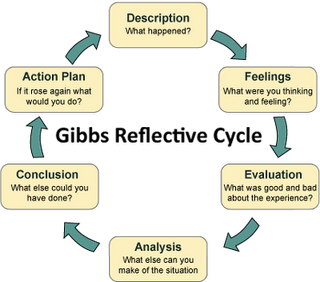
This is a useful practical model to use, and the questions provide a good guide to the process to follow. What strengthens this model is to also consider the questions from the position of others who may have been involved, to try and see the issues from more than one angle.
4. Progress Tracking and Monitoring
This is best kept on your electronic device, possibly setting up an Excel spreadsheet. This may include:
- Overview of your Individual Needs Assessment;
- Individual learning objectives for KSBs;
- Identification of high priority ‘hard to reach’ KSBs which are not part of your everyday job. Indicating these development areas using R-A-G (red, amber, green) can help with monitoring your progress with your tutor and Work Based Mentor.
Further reading:
- Bassot, B. (2006) The Reflective Journal (2nd Ed). Basingstoke: Palgrave-MacMillan
- Gibbs, G. (1998) Learning by doing: a guide to teaching and learning methods. London: F.E.U.
- Kolb, D.A. (1984) Experiential Learning: Experience as a Source of Learning and Development. New Jersey: Prentice-Hall.
- Mesirow, J. (1992) Fostering critical reflection in adulthood: a guide to transformative and emancipatory learning. San Francisco: Jossey-Bass Publishers.
- Redmond, B. (2004) Reflection in action: developing reflective practice in health and social services. Aldershot: Ashgate.
- Schein, E.H. (1998) Process consultation revisited, building the helping relationship. London: Addison-Wesley Publishing Company.
- Useful web resources
Infed (2001) Donald Schon (Schön): Learning, reflection and change. Available at: http://infed.org/mobi/donald-schon-learning-reflection-change/ - Links to an external site. (Accessed 2 August 2019).
- Daskal, L. (no date) Leadership reflection: the strength to change ourselves. Available at: https://www.lollydaskal.com/leadership/leadership-reflection-strength-change/
Links to an external site. (Accessed 2 August 2019).